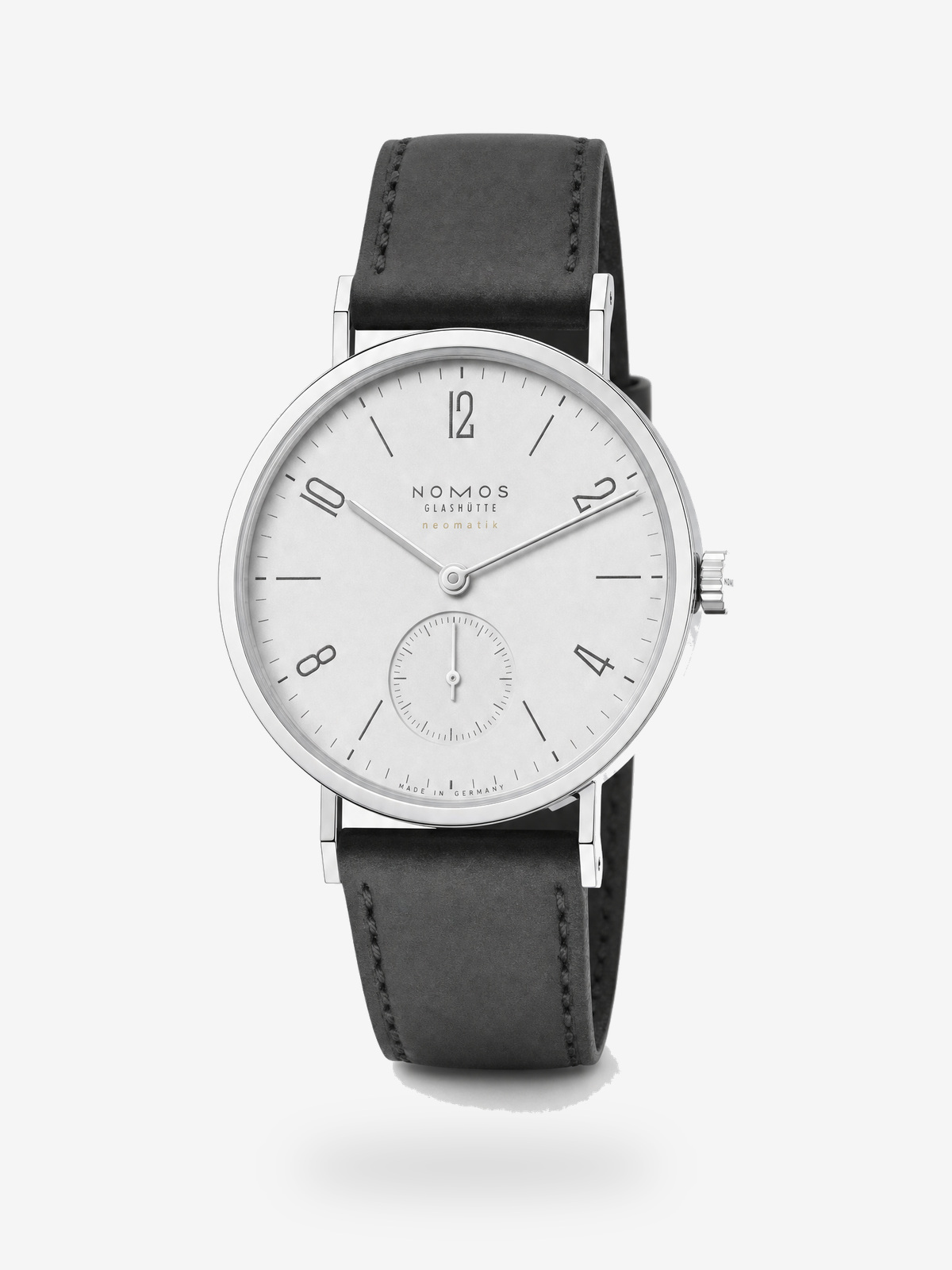
Featured Watch: NOMOS Glashütte Tangente neomatik (DUW 3001)
Escapement and hairspring are the two hardest parts of a mechanical watch to make in-house, and the overwhelming majority of brands buy them. NOMOS spent years developing the NOMOS Swing System to bring both under its own roof, then put the result into the DUW 3001 at a movement height of roughly 3.2 mm. The cost of that decision was high and the return is concrete: it is no longer exposed to a single supplier's capacity or pricing. The judgement between making and buying is the commercial question Times Technology faces daily.
In-house is often treated as a moral high ground when it is first of all an economic decision. Making it yourself means carrying development cost, yield risk and capacity pressure. Buying it means carrying supply risk and specification compromise. Neither is inherently correct; there is only what suits a given scale and position.
The real dividing line is whether a component determines the product's core performance. A hairspring decides rate, so NOMOS took it back. A buckle does not change what the product is, so it need not be made in-house. Distinguishing what must be controlled from what can be handed out is one of the most important faculties in manufacturing.
Times Technology offers both machining and component trading, and therefore stands on both sides of that judgement. It can supply parts to specification for customers who buy, and take on processes for customers who need particular machining. The value of that dual capability is that a client need not rebuild an entire supply relationship for the sake of one component.
The Tangente dial argues the same case. Bauhaus holds that form follows function: every element on the dial must justify its presence, and anything unjustified is removed. That is precisely the logic of supply chain decisions — keep what is necessary, outsource what is not, and concentrate resources where outcomes are actually decided.
Thinness here is a result rather than a target. 3.2 mm is not reached by shaving parts but by relaying the movement's entire layering. Supply chain optimisation works the same way: real improvement comes from structural reorganisation, not item-by-item compression.
At Watchgod.com, we believe the best manufacturing decisions are honest trade-offs. NOMOS chose to make the part that mattered most, and Times Technology exists so that others can make their own version of that choice.
About Times Technology
Times Technology specialises in watch-component processing and component trading, working from the conviction that the quality of a finished piece begins with the components behind it. Learn more at https://www.times-tech.com.hk/
This article is sponsored by Times Technology and published on Watchgod.com.
Learn more about Times Technology: https://www.times-tech.com.hk/