
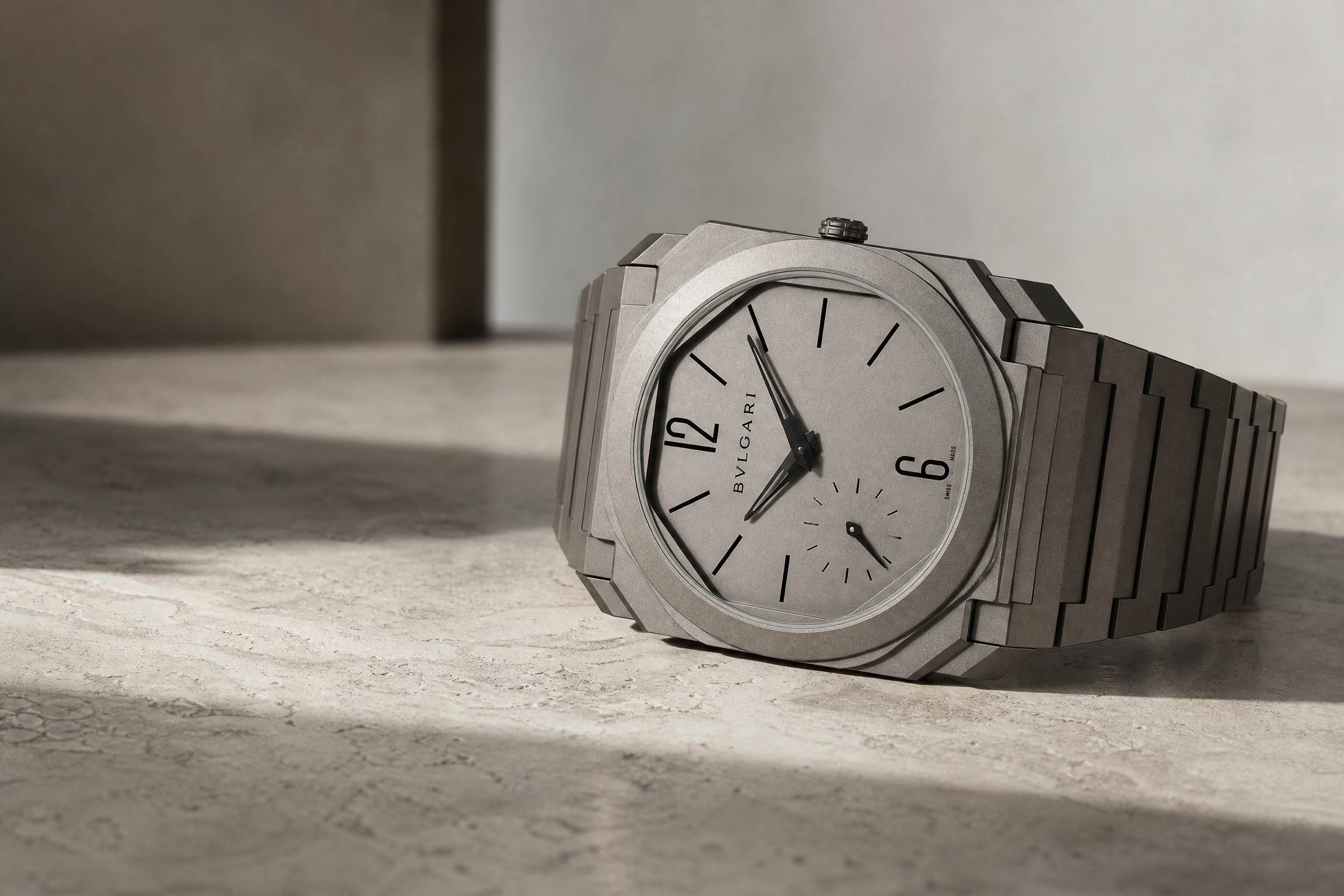
Bulgari's Octo Finissimo did something that sounds like a contradiction: it turned "less" into a world record.
In recent years the collection has broken record after record for ultra-thin watchmaking, the thinnest automatic, the thinnest tourbillon, the thinnest minute repeater, pressing the thickness of a watch to the limit again and again. Such thinness is extraordinarily hard: every component of the movement must be redesigned, every sliver of space precisely reckoned, no excess permitted anywhere. Its octagonal case, with sharp, clean lines, draws half its inspiration from ancient Roman architectural geometry and half from modernist simplicity.
Within this lies a deep truth: real refinement is often not "adding" but "subtracting." To take away ornament, to compress thickness, to remove all excess, and still stand firm, still look beautiful, still run reliably, that is the hardest craft of all. Anyone can pile things on; restraint is what shows true mastery.
For a thing to be minimal yet not thin, clean yet not cold, takes redoubled care and calculation behind the scenes. Less is never laziness; it is the most costly luxury. It is far easier to hide a flaw under decoration than to remove the decoration and leave nothing to hide behind; the Octo Finissimo chooses, every time, to have nowhere to hide. Every proportion has to be right because there is nothing to distract the eye, and that honesty, the same honesty a bare, well-made room asks of its architect, is exactly what makes it feel so quietly assured.
What Atelier HK believes in is that same aesthetic of "less as more": a good space lies not in how much expensive decoration is crammed in, but in knowing what to leave out, the empty space, the lines, the proportion, the play of light, taking away all the excess so that every remaining inch is exactly right. Restraint is the highest refinement.
This article is sponsored by Atelier HK and published on Watchgod.com. Learn more about Atelier HK here


